
Description
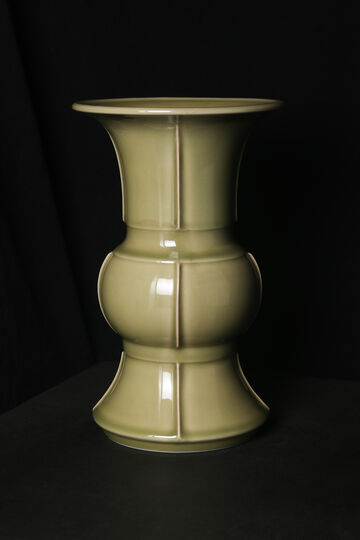
This exceptional celadon Chuji Gu stands as a distilled embodiment of the Song dynasty’s celebrated revivalist aesthetic, in which ancient ritual forms were reinterpreted through refined ceramic language. The vessel’s form directly references the bronze gu of the Shang and Zhou dynasties, distinguished by its outward-flaring trumpet mouth and raised ridges (chuji). The silhouette is dignified, solid, and composed, conveying a quiet authority imbued with the Confucian restraint admired by Song literati.
In the Bronze Age, Chuji Gu vessels represented one of the most technically complex ritual forms, typically produced using three-section composite molds. This tripartite structure—flared mouth, swelling drum-shaped body, and expansive ring foot—had long been established as a canonical model. The present work faithfully follows this ancient structural logic. Executed in porcelain rather than bronze, the form demanded exceptional technical control: each section had to be precisely proportioned and seamlessly joined to achieve stability, vertical tension, and visual harmony. The result is a vessel that rises firmly and confidently, solemn yet elegant, commanding presence without excess.
The chuji gu form itself is not an arbitrary creation, but a deliberate act of homage. Song dynasty intellectuals revered the ritual systems of the “Three Ancient Dynasties,” and Longquan kiln artisans responded by transforming the gravity of bronze ritual vessels into the softer, more contemplative medium of celadon. Elaborate bronze ornamentation was distilled into clean, projecting ridgelines; the cold, rigid surface of metal was replaced by a jade-like glaze of gentle translucence. Archaeological evidence confirms that Southern Song celadon frequently adopted archaic bronze forms—li-tripod censers, ding-shaped vessels, and ritual beakers such as this Chuji Gu—expressing the cultural ideal of “rendering ritual propriety through porcelain.”
Equally compelling is the glaze, a masterful example of kiln transmutation (yaobian), encapsulated in the adage: “One color enters the kiln; a thousand hues emerge.” The soft, pale green surface is not the result of strict control, but of subtle variations in temperature and atmosphere within the dragon kiln. These fluctuations caused metallic oxides in the glaze to react unpredictably—once regarded as flaws, later celebrated by Song literati as manifestations of natural, uncontrived beauty and philosophical restraint.
The kiln effects on this Chuji Gu are particularly distinguished. Across the raised flanges and ridgelines, the glaze thins, allowing the pale grey-white body to subtly emerge, creating a refined “exposed ridge” (chu jin) effect. In contrast, the pooled glaze along the swelling body deepens into a rich, plum-green tone with pronounced glassy depth.
As recorded in early historical sources:
“Though the material is one, it becomes many; though the color is one, it transforms into countless hues—formed by water and earth, beyond the reach of human artifice. This is what is called kiln transmutation.”
窑变出戟觚
Gu Beaker with Raised Ridges and Kiln-Transmutation Glaze
by Liu Xiaodong
$9700
About the Artist
Highlights