
From Persia to the Tomb
Foreign Influence, Funerary Beliefs, and Historical Change in Two DMA Celadon Vessels
The Poetic Spectrum of Celadon at the DMA
Among the most poetic achievements of Chinese ceramics is celadon, a term that evokes not a single formula but a spectrum of green glazes, from pale mist to deep jade. The Dallas Museum of Art (DMA) houses two exceptional lidded vessels from the Longquan kilns of Zhejiang province that offer a focused view of this evolution. The earlier piece, a Bottle with Lid (975 1000 CE, Northern Song dynasty), is a stoneware vessel covered in a glassy, pale green glaze. The later piece, a Vase with Cover (1100 1200 CE, Southern Song dynasty), is a porcelain container with a richer, more opaque celadon glaze and molded decoration, including a small tiger chasing a ribbon tied ball. Together, these two DMA objects reveal a crucial transition in Chinese ceramic history: from the more translucent, thinly glazed wares of the Northern Song to the thick, jade like glazes and complex sculptural symbolism of the Southern Song. At the same time, both vessels share a common funerary purpose. They were not merely decorative but were made to store provisions for the afterlife, placed in tombs as part of a structured cosmology. By examining these two DMA works side by side, one can trace the intertwining threads of foreign influence, changing funerary beliefs, and profound historical transformation that defined Song dynasty ceramic art.
The DMA's Northern Song Bottle: Glassy Pale Green and Near Eastern Influence
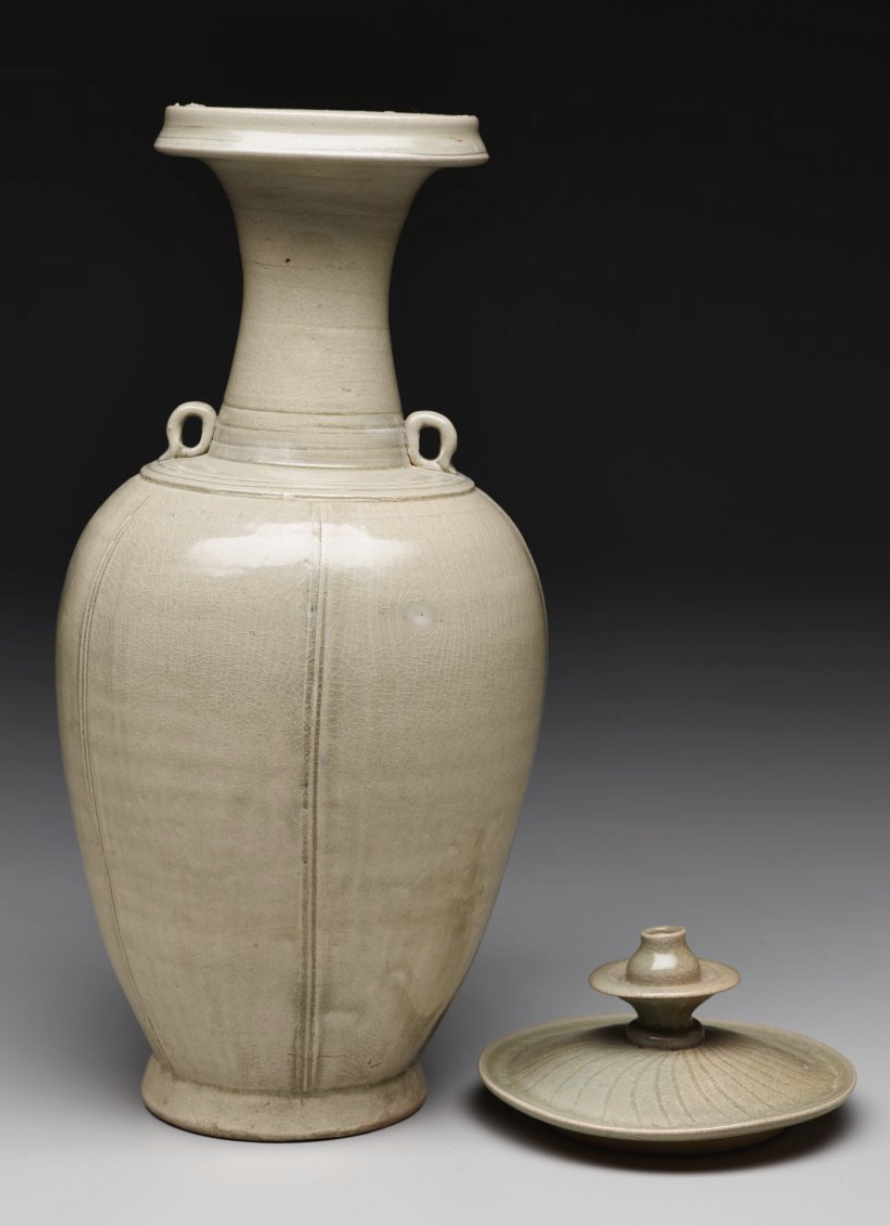
The Northern Song bottle (975 1000 CE) in the Dallas Museum of Art belongs to the formative period of Longquan ware, before the kilns of Zhejiang became the dominant producers of celadon. Its most striking feature is the glassy, pale green glaze, thin enough to reveal the incised decoration beneath, yet lustrous enough to catch light like polished nephrite. According to DMA curatorial notes, this "glassy pale green glaze ... is a precursor to the thick, opaque celadon glazes of the later Southern Song period." Technically, this means the glaze contains relatively low amounts of iron oxide and is fired in a reduction atmosphere, but the visual effect is one of delicacy and restraint.
The most telling evidence of foreign influence appears in the vessel's form. The elongated, egg shaped body is divided into six vertical lobes by incised grooves, a design that mimics the seams of a silver vessel. Indeed, the DMA label explicitly states that the bottle "was likely modeled after silver vessels from the Near East." This is a remarkable testament to the cosmopolitan exchange along the Silk Road during the Northern Song period. Despite political tensions with northern nomadic powers, the Song court maintained vigorous overland and maritime trade with Central Asia, the Islamic world, and beyond. Luxury goods such as Persian metalwork entered China and were eagerly copied by Chinese artisans. The Longquan potter who made this bottle looked not to native ceramic tradition but to a silver flask from somewhere west of the Pamir Mountains. The trumpet neck flares to a sharply formed dish shaped mouth, and the DMA's example retains its original lid with an upturned rim, a rarity as most such lids have been lost.
In terms of funerary belief, this bottle follows the ancient Chinese tradition of supplying the tomb with provisions for the afterlife. Its shape, a lidded jar with a narrow neck, is typical of containers for grain or wine placed in burial chambers. However, the choice of a foreign inspired form for such a sacred purpose is significant. It suggests that in the Northern Song, the exotic carried prestige. A vessel shaped like a distant luxury could better honor the deceased and signal the family's wealth and cosmopolitan awareness. The pale celadon color, which the Chinese poetically compared to "the color of mist after rain," would have conveyed a sense of coolness and permanence appropriate for the afterlife. The elongated form and vertical grooves also create a rhythm of light and shadow, making the vessel appear taller and more slender than its actual dimensions. As one of the finest Northern Song celadons in the DMA's collection, this bottle represents a moment of experimentation when Longquan potters were still perfecting their clay body and glaze recipes while looking to metalwork for inspiration. The result is a hybrid object, part Chinese ceramic tradition, part Central Asian metallic form, yet unmistakably celadon.
The DMA's Southern Song Vase: Thick Opaque Glaze and Cosmological Symbolism
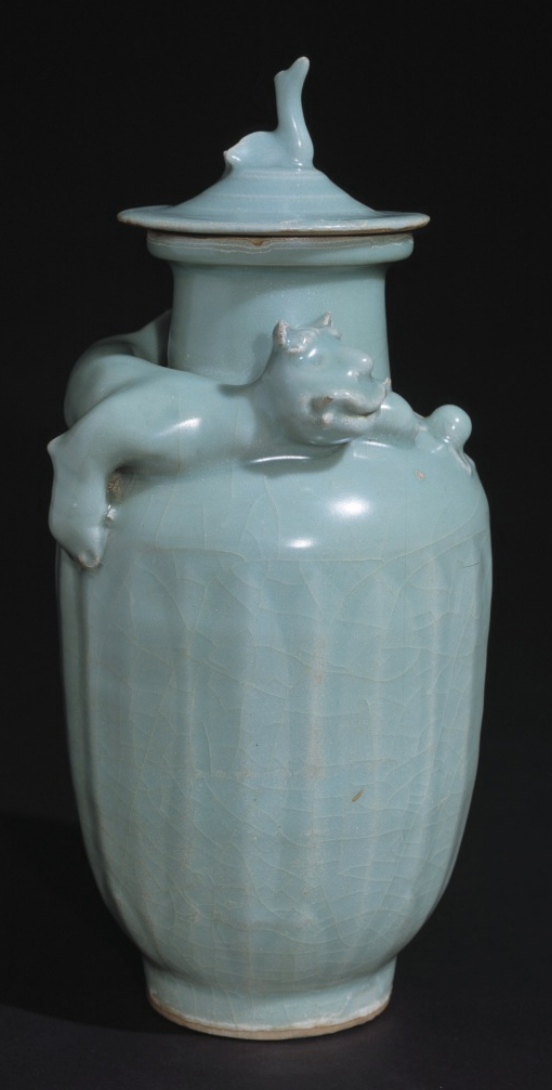
A century later, the Southern Song vase with cover (1100 1200 CE) in the Dallas Museum of Art demonstrates how fundamentally historical change had reshaped Chinese ceramic art. By this time, the Song court had lost all of northern China to the Jurchen Jin dynasty and retreated south to Hangzhou. This was a traumatic event, often called the Jingkang Incident (1127 CE), in which the Northern Song capital fell and the emperor was taken captive. The surviving Song princes established a new capital in the south, and the Longquan kilns, now located in the heart of the new territory, flourished under imperial and elite patronage. This historical shift from north to south is not merely political background; it directly shaped the aesthetics and symbolism of the later vase.
The DMA's Southern Song vase is made of porcelain, a finer, whiter clay than the earlier stoneware, and is covered in a thicker, more opaque celadon glaze. Where the Northern Song bottle emphasizes carved lines derived from metalwork, this vase uses molded decoration: a lotus pattern incised on the body, and a small tiger curving around the neck, chasing a ribbon tied ball. The foreign influence of the earlier piece has been fully absorbed and replaced by native Chinese symbolism. The lotus is a Buddhist emblem of purity and rebirth, a flower that grows from mud but blooms unstained. Its presence on a funerary vessel reflects the growing influence of Buddhist beliefs about death and reincarnation during the Southern Song.
The tiger, however, carries an even more specific cosmological meaning. According to the DMA description, "This vase represents the White Tiger of the West," one of the four directional beasts that, since the Han dynasty, protected tombs and guided the soul. The other three would have been the Azure Dragon of the East, the Red Bird of the South, and the Black Tortoise of the North. Originally, this vase was most likely one of a set, four lidded vases placed in the four cardinal directions of a tomb, each storing provisions for the deceased. The symbolism of the White Tiger (Baihu) is dense with meaning. In Chinese cosmology, the tiger represents the west, autumn, metal, and the yin principle of death and endings. But it is also a protector: its image wards off evil spirits and ensures safe passage to the afterlife. By placing a small ceramic tiger on the neck of a grain jar, the potter fused practical storage with cosmic guardianship. The ribbon tied ball (sometimes called an "embroidered ball" or xiuqiu) adds a note of play and festivity, suggesting that the afterlife was imagined not as grim but as a continuation of earthly pleasures.
The historical change from Northern to Southern Song is crucial to understanding this DMA vase. After losing the north, the Southern Song court consciously revived and intensified traditional Chinese cosmology as a way of asserting cultural continuity and legitimacy. The Four Directional Beasts, the yin yang system, and the five elements all received renewed attention. A tomb equipped with four vases bearing these symbols was not just a burial; it was a declaration that even in exile, the Song people remembered and honored the old ways. The foreign inspired form of the DMA's Northern Song bottle had given way to a thoroughly native symbolic language in its Southern Song counterpart.
A Comparative Analysis: Two DMA Masterworks Compared
Comparing the two DMA vessels side by side, one sees a trajectory shaped by foreign influence, historical upheaval, and evolving funerary beliefs. The Northern Song bottle is elegant but restrained. Its foreign inspired shape, pale glaze, and incised lobes speak of trade and technical learning. It is a fine object, but its meaning is generalized. It holds provisions, and it looks beautiful. The Southern Song vase, by contrast, is loaded with specific cosmological references. The tiger is not just an animal but a directional guardian; the lotus is not just a flower but a Buddhist emblem; the set of four vases would have mapped a metaphysical order onto the tomb itself. The later vase tells a more complex story, about the loss of the north, the consolidation of Southern Song culture, and the blending of Daoist, Buddhist, and folk beliefs in mortuary practice.
Yet for all their differences, both DMA vessels share a fundamental belief: that death is a continuation of life in another realm, and that beautiful, well made objects can sustain the soul. The Northern Song bottle's pale green glaze, reminiscent of morning mist, suggests a gentle transition. The Southern Song vase's jade like thickness and the fierce but playful tiger suggest a more guarded passage, requiring spiritual protection. Both were placed in tombs, filled with grain or other offerings, and sealed with their lids. In this sense, they are not merely works of art but functional ritual objects. Their beauty served a practical purpose: to honor the dead and to ensure their comfort in the next world. The fact that DMA visitors can still appreciate their aesthetic qualities today is a testament to the skill of the Longquan potters who understood that even a container for grain could be a vessel of transcendence. Together, the Northern Song bottle and the Southern Song vase in the Dallas Museum of Art bracket a golden age of Chinese celadon. The earlier piece shows the promise of Longquan ware: experimental, cross cultural, and delicately beautiful. It is a product of a confident Northern Song China that could look to Persia for inspiration and transform a silver flask into a jade like jar for a tomb. The later piece shows its fulfillment: technically masterful, symbolically rich, and profoundly integrated with Chinese cosmology. It is a product of a traumatized but resilient Southern Song China that turned inward, reviving ancient symbols of protection to guard the souls of the dead. Thanks to the DMA's commitment to collecting and displaying such works, these two vessels now serve not as tomb furnishings but as teachers, telling modern audiences the story of how a culture refined its taste, deepened its beliefs, and learned to transform a simple clay jar into a guardian of the soul. From Persia to the tomb, from foreign silver to the White Tiger of the West, these two DMA celadon vessels carry us across a century of profound historical change.Shared Funerary Purpose: Provisions for the Afterlife
Two Bookends of a Golden Age at the DMA