
From Diancai to Tobiseiji
Rethinking Flaw and Perfection in Chinese and Japanese Ceramic Aesthetics
In the history of Chinese ceramics, a special category of ware exists that challenges conventional notions of beauty. This is the dotted celadon, known academically in China as qingyou heban (青釉褐斑) or diancai (点彩), and known in Japan by the poetic name Tobiseiji (飛青磁), meaning "flying" or "splashed" celadon. Unlike the flawless, monochromatic celadons that represent the ideal of Song dynasty (960-1279) taste, these wares feature irregular, seemingly spontaneous splashes of dark iron brown spots across a luminous green glaze. What was long considered a minor or even inferior style in its homeland became, in the eyes of Japanese connoisseurs, the very definition of a masterpiece. The story of the dotted vase is a profound lesson in the cultural construction of value, the shifting hierarchies of beauty, and the remarkable journey of an art form across the East China Sea.
The Chinese Origins of Dotted Color
The technique of applying brown spots to green glazed ceramics has ancient roots in China. The method is deceptively simple. After applying the base celadon glaze, the potter would use a brush or bamboo tube to spatter or dot a concentrated iron oxide rich slip onto the still wet surface. When fired in a reduction kiln, the iron in the spots oxidized to a deep russet or rust brown, while the surrounding glaze transformed into the coveted jade like green. The result was a dramatic contrast, a field of cool, serene green punctuated by hot, dynamic bursts of brown.
During the Song dynasty, when Longquan celadon reached its technical and aesthetic peak, the dotted style was already being produced. However, it occupied a marginal position within the Chinese ceramic tradition. The literati taste, deeply influenced by Confucian ideals of harmony and Neo Confucian subtlety, prized the reserved and the immaculate. The ideal celadon was a vessel of perfect uniformity, a surface that invited quiet contemplation without distraction. A brown spot was, by this standard, a flaw. It broke the silence, interrupted the perfection, and deviated from the ideal of the vessel as a flawless piece of jade.
Consequently, dotted celadon was produced primarily for export. During the Yuan dynasty (1271-1368), when maritime trade expanded dramatically, these wares found their way to Southeast Asia, the Middle East, and particularly Japan. Chinese potters continued to make them, not as their finest work, but as a commercial sideline for foreign markets that, for reasons the Chinese did not fully understand, seemed to appreciate the very feature that Chinese connoisseurs dismissed.
The Japanese Transformation
When the first dotted celadon vessels arrived in Japan during the Kamakura (鎌倉時代, 1185-1333) and Muromachi (室町時代, 1336-1573) periods, they encountered an aesthetic ecosystem perfectly prepared to receive them. The Japanese tea ceremony (茶道, chanoyu) was evolving from an aristocratic pastime into a spiritual discipline deeply influenced by Zen Buddhism (禅宗). This tradition championed wabi sabi (侘寂), a worldview centered on the acceptance of transience, imperfection, and austerity. Wabi sabi finds beauty in the cracked, the weathered, and the incomplete, valuing the mark of time and the hand of the maker above mechanical perfection. The perfect, the new, and the symmetrical were valued less than the weathered, the asymmetrical, and the humble. Objects that bore the mark of the potter's unguarded hand, or of natural processes, were seen as containing a deeper, more honest beauty.
In this light, the brown spots on the dotted celadon were not flaws at all. They were revelations. They were the very qualities that made the vessel alive. The spontaneous splashes were understood as expressions of shibui (渋い), an understated, astringent elegance that suggests depth without ostentation. The contrast between the expansive, silent green and the small, active brown spots created a visual tension, a dynamic interplay that engaged the eye. The green became the void (虚空), the ma (間), the powerful, meaningful pause (余白) in Japanese art and aesthetics. The brown spots became the event, the fleeting moment of perception, the sudden awakening. This dialogue perfectly mirrored the tea ceremony itself: a structured, silent ritual punctuated by the sharp sound of the whisk, or a single, telling word from the host.
The Japanese gave this ware a new name: Tobiseiji (飛青磁, or "flying celadon"), evoking the sense that the spots seemed to fly across the glaze like birds across a green sky. What had been a term of dismissal in China, "brown spotted ware," became a term of endearment and reverence in Japan.
The Two Vases of Osaka
Cultural Reflections: Who Decides What Is Beautiful?
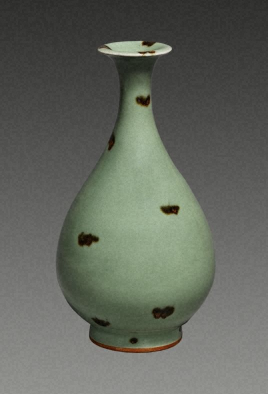
The Museum of Oriental Ceramics, Osaka (大阪市立东洋陶瓷美术馆) houses two exemplary dotted celadon vases, both of the yuhuchun (玉壶春, pear-shaped) form, both originating from the Yuan dynasty Longquan kilns. Yet they hold different official ranks, and their comparison illuminates the refined standards by which Japanese connoisseurs judge these works.
The National Treasure (国宝, kokuhō) is a Yuan dynasty Longquan celadon dotted color Yuhuchun vase of standard proportions, featuring approximately twenty iron brown spots masterfully arranged across its surface. The spots are neither uniform nor random. They vary in size: some are bold and large, others delicate and small. They wander up the slender neck, cluster on the shoulder, and dance across the widest part of the bulbous body. Crucially, their placement is never haphazard. The potter appears to have listened to the form of the vase, placing each dot exactly where the visual field demanded punctuation. The elegant, elongated neck flows smoothly into a full, generous belly, creating a silhouette of perfect classical grace. The vase was formerly part of the renowned Ataka Collection (安宅コレクション) before entering the museum. Its lush, luminous blue green celadon glaze is of breathtaking depth, providing a serene landscape against which the brown spots perform their dynamic dance. Designated a Japanese National Treasure in 1952, this piece is widely hailed as the archetypal masterpiece of the dotted celadon style, a perfect union of Chinese craftsmanship and Japanese aesthetic appreciation.

A second dotted vase also resides in the same museum. It is slightly smaller, standing 1.7 centimeters shorter than the National Treasure. It bears only eleven brown spots, which are somewhat larger and more sparsely distributed across its surface. The overall proportion of the vase is slightly more compact, with a neck and body that transition less seamlessly than those of the National Treasure. This piece was formerly owned by Matsumoto Matsuzo (松元枩藏) and was more recently donated to the museum by an anonymous donor. While it is undoubtedly a fine and historically significant object, it has been designated only as an Important Cultural Property (重要文化財, jūyō bunkazai), a notable but distinctly lower rank. In November 2025, the Museum of Oriental Ceramics exhibited these two vases side by side, allowing viewers to appreciate directly how subtle differences in spotting, proportion, and overall harmony can elevate one piece to the highest level of cultural recognition while another, though lovely, remains in its shadow.
The Contemporary Chinese Revival
In recent decades, the dotted celadon tradition has undergone a significant revival in its homeland. Contemporary Chinese potters, particularly those working in Longquan, have begun to reexamine the style that was long dismissed as a minor export ware. This renewed interest is part of a broader movement to recover and reinterpret Song Yuan aesthetics, driven by growing cultural confidence and a more globalized understanding of art history.
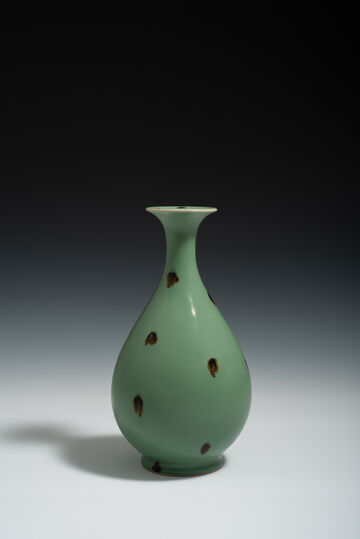
Representative of this trend is the potter Xu Jianxin (徐建新), whose work "Dotted Color Yuhuchun Vase" (点彩玉壶春) exemplifies the contemporary Chinese approach. Xu's vase strictly follows the classic Song dynasty Yuhuchun proportions: a flared mouth, slender neck, drooping bulbous body, and shallow ring foot. The name yuhuchun, meaning "jade pot in spring," derives from a famous line by the Tang dynasty (618-907) poet Wang Changling (王昌龄): "If friends in Luoyang inquire of me, my heart is like ice in a jade pot" (洛阳亲友如相问, 一片冰心在玉壶). This poetic allusion has long symbolized purity, moral clarity, and the refined spirit of the Chinese scholar official.
Xu uses a plum green (meiziqing, 梅子青) glaze, fired in a reduction kiln to achieve the thick, translucent, jade like quality that defines classic Longquan celadon. The brown spots are applied using traditional methods, and Xu describes them in terms drawn from classical Chinese aesthetics: "falling petals on a verdant glaze" or "floating duckweed on clear water." These metaphors emphasize naturalness, spontaneity, and the principle of "beauty arising from nature."
Importantly, Xu's work is not produced for export to foreign markets. It is created for a domestic audience of collectors and connoisseurs who have come to appreciate the dotted style on its own terms. This represents a significant shift from the Yuan dynasty, when such wares were made primarily for Japanese and other overseas buyers. The contemporary Chinese dotted vase is an assertion of cultural reclamation, a recognition that a tradition once considered marginal is, in fact, a legitimate and valuable part of China's ceramic heritage.
The history of the dotted vase raises fundamental questions about the nature of aesthetic value. Is beauty inherent in the object itself, or is it conferred by the viewer? The same Yuan dynasty vase, with the same glaze, the same spots, the same imperfections, can be a provincial curiosity in one culture and a National Treasure in another. The Chinese literatus saw a flaw. The Japanese tea master saw a revelation. Who was correct?
The answer, of course, is that both were correct according to the standards of their respective traditions. The Chinese scholar operated within an aesthetic system that valued purity, uniformity, and the flawless emulation of jade. The Japanese tea master operated within a system that valued naturalness, asymmetry, and the expressive mark of the human hand. Neither system is objectively superior; each is a coherent set of values developed over centuries within a specific cultural context.
What makes the dotted vase so instructive is that it participated in both systems. It was made by Chinese hands, according to Chinese techniques, within a Chinese ceramic tradition. But its fullest appreciation, its elevation to the status of National Treasure, occurred in Japan. The vase is, in a sense, a Chinese object with a Japanese soul. It embodies the meeting of two great aesthetic traditions, and it reminds us that art is not a fixed quantity but a fluid relationship between object, viewer, and culture.
The Signature of History
The dotted vase traveled from the kilns of Longquan to the tea houses of Japan, from the margins of Chinese taste to the center of Japanese cultural heritage. It was overlooked by Chinese literati and revered by Japanese tea masters. It was made for export and returned home as an inspiration. Today, it is being remade by Chinese potters who have learned to see it with new eyes, eyes that have traveled to Osaka and back, eyes that have been trained by both traditions.
The brown spots were never flaws. They are signatures of history, marks of cross cultural dialogue, and testaments to the enduring power of an art form to carry different meanings across different shores. When the Chinese potter Xu Jianxin applies those spots to his Yuhuchun vase, he is not imitating a Japanese taste. He is reclaiming a lost chapter of his own tradition, one that took a detour through Japan before returning home. The spots are still brown. The glaze is still green. But the meaning has come full circle, from China to Japan and back again, enriched by the journey.
The dotted vase teaches us that beauty is not a fixed star but a conversation. It is made and remade, seen and reseen, across centuries and oceans. And sometimes, a flaw is not a flaw at all. Sometimes, it is the beginning of a masterpiece.